Back After the Halving: Relearning the Ropes at 63 TH/s
Returning miners find a familiar game with unfamiliar numbers. Subsidy now sits at 3.125 BTC per block, and a 63 TH/s unit earns about 2.826e-05 BTC daily, near $2.39 gross or $2.30 after the listed charge. This guide bridges the gap between remembered habits and present-day figures.
Key takeaways
- 63 TH/s earns near 2.826e-05 BTC a day, about $2.39 gross at $84,692 per BTC.
- The listed 4% on the block-reward component leaves close to $2.30 daily.
- Subsidy per block is 3.125 BTC with 144 blocks daily, 450 BTC network-wide.
- Old stratum URLs, firmware and payout addresses all need re-verification.
What the old-timer remembers correctly
Much of the craft survived intact. Shares still prove work, difficulty still normalizes luck across the network and pools still smooth individual variance into regular income. A returning miner who last hashed when blocks paid double will recognize every dashboard element within minutes. The instincts about uptime, cooling and clean power remain exactly as valuable as ever.
The arithmetic skeleton is unchanged too. Personal hashrate divided by network hashrate, times daily issuance, equals personal coins before charges. What changed are the inputs plugged into that skeleton: the subsidy halved to 3.125 BTC, total throughput climbed near 1,003 EH/s and difficulty rests at 132.76 T. Same formula, leaner answers.
One comfort awaits: the ecosystem matured around the miner. A single all-in-one multi-coin pool now serves 150-plus countries with over a million accounts, folding wallets, monitoring and 20-plus coins including LTC, BCH, KAS and merged DOGE mining into one login. Less tab-hopping, same hashing.
Auditing the gear left in storage
Drag everything into daylight before spending a cent. Inspect each unit for swollen capacitors, seized fans and corroded connectors, then test power supplies under load with a meter rather than trust. Firmware from years ago may refuse current stratum endpoints, so check for updates from the manufacturer before diagnosing connection failures as hardware death.
Benchmark honestly against the present. A surviving 63 TH/s machine keeps about $2.30 a day after the listed 4%, which covers residential power only where tariffs are gentle. The ViaBTC Mining Guide set walks through current BTC, LTC, BCH and KAS onboarding per coin, so confirm the intended coin's guide matches the hardware's algorithm before repointing anything.
Retire without sentiment what the numbers condemn. A unit whose daily kept income trails its power cost by a wide margin becomes a heater with extra steps, and heaters are cheaper to buy. Keep one relic for testing configurations if nostalgia demands, and sell or recycle the rest toward efficient replacements.
Relearning settlement: hourly versus shared
Two settlement styles now share the menu, and the choice matters more than it used to. PPS+, the default, settles the block-reward slice hourly against current difficulty with a listed 4% on that component, while the transaction-fee slice follows PPLNS logic at a listed 2%. The alternative PPLNS scheme merges both into one distribution at a listed 2% combined, paying after 6 confirmations across the trailing 5 difficulty rounds.
For a returnee rebuilding confidence, the hourly path is the gentler re-entry. Credits arrive 24 times a day in predictable increments, so configuration errors surface within hours rather than hiding inside pool variance. At 63 TH/s that means watching roughly 1.18e-06 BTC land each hour, about ten cents at $84,692, and confirming the staircase climbs evenly through the night.
Later, with uptime proven above 98% for a month, the shared scheme becomes worth measuring. Its average usually exceeds the PPS+ net at the cost of lumpy days, a trade steady operations can accept. A forward income estimator refreshes the gross baseline at 63, 252 and 630 TH/s whenever curiosity about bigger iron strikes.
Three rungs for the comeback budget
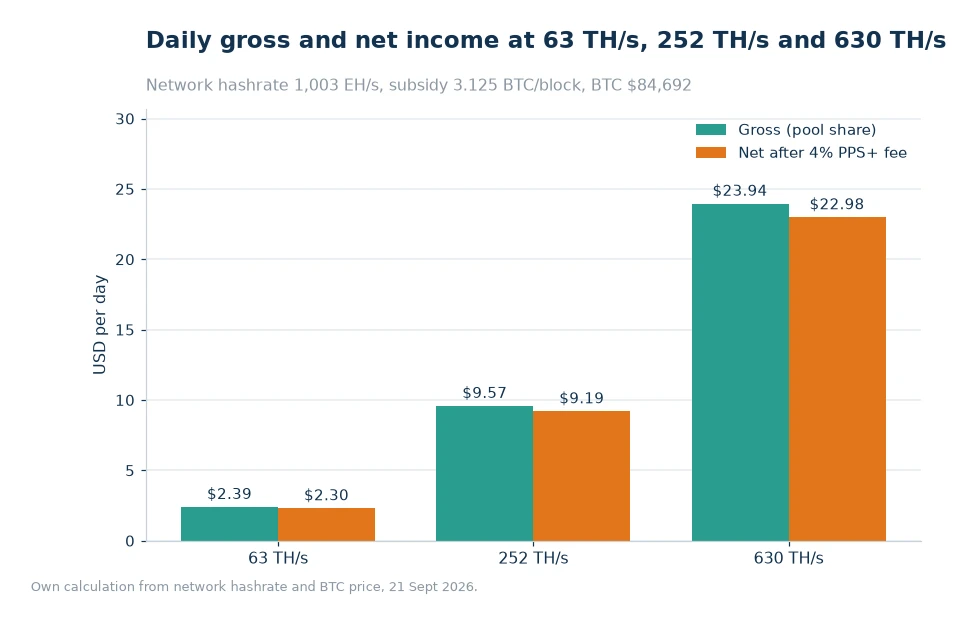
The chart maps the returnee's realistic path: the rediscovered 63 TH/s unit, a 252 TH/s shelf addition and a 630 TH/s committed row. Daily kept income runs $2.30, $9.19 and $22.98 respectively at $84,692. The table below stretches those into quarterly figures, the horizon over which comeback plans should be judged.
| Comeback stage | Daily kept | Quarter kept | BTC per quarter |
|---|---|---|---|
| 63 TH/s rediscovered | $2.30 | $207.00 | 0.00244340 |
| 252 TH/s extended | $9.19 | $827.10 | 0.00977380 |
| 630 TH/s committed | $22.98 | $2,068.20 | 0.02443460 |
Fund each stage from the prior stage's surplus plus fresh capital in fixed proportion, never from optimistic projections. Difficulty's next move is estimated near minus 2.12%, but estimates swing, and budgets built on today's difficulty with a ten-percent haircut survive most adjustments. The pool's Statistics view, with Pool Hashrate and network context side by side, keeps the plan tethered to reality.
Reusing the old wallet without reusing old mistakes
The previous payout address may still be valid, but verify its ownership before pointing fresh earnings at it. Open the wallet, confirm access with a small test transaction and check that withdrawal destinations match current intentions. Years-old address books collect exchange deposit tags and retired accounts; sending the first new coins to a dead destination would be a harsh homecoming.
Consolidate dust while the operation is small. Tiny leftover balances scattered across old workers and addresses complicate every future reconciliation, so sweep them into one holding address during the first week back. Record the transaction identifiers beside the quarterly ledger so the sweep never looks like missing income later. Clean books from day one keep the comeback story legible.
Security habits deserve the same audit as hardware. Rotate passwords on the pool account, enable every available second factor and confirm that API keys from the previous era are revoked. A returnee's account is a stranger's opportunity only if old credentials still open doors, so treat credential hygiene as part of the recommissioning checklist alongside firmware and airflow.
Old peripherals deserve inspection too. Cables stiffened by years in storage, clogged power strips and tired surge protectors cause a surprising share of comeback failures, so replace the cheap parts unconditionally and keep receipts with the quarterly ledger. Fresh copper and clean contacts cost little and remove a whole category of midnight mysteries before the first share is even submitted, which is the cheapest reliability upgrade available.
Worked example
Recompute the homecoming baseline. Daily BTC per TH/s is 450 divided by 1,003,000,000, or 0.00000044865. Times 63 gives 2.826e-05 BTC per day, the chart figure. Times $84,692 gives $2.39 gross. The listed 4% on the block-reward component keeps 96%: $2.39 times 0.96 equals $2.30 net. The committed rung follows: 630 times 0.00000044865 gives 0.00028262 BTC a day, times 84,692 equals $23.94 gross, times 0.96 equals $22.98 net, and ninety such days total $2,068.20 as shown above.
Frequently asked questions
Is my old pool account still usable?
Often yes, but verify everything. Update the payout address, confirm the worker names, and re-check the settlement setting, since defaults and fee schedules evolved while the account sat idle.
Should a returnee start with PPS+ or PPLNS?
Start with PPS+. Hourly settlement at a listed 4% on the block reward confirms the setup quickly; consider PPLNS after a month of proven uptime if steadier averages appeal less than higher expected value.
What kills most comeback attempts?
Power price amnesia. Tariffs remembered from years ago rarely match today's bill, and at $2.30 kept per day a 63 TH/s unit leaves no room for an unpleasant surprise.
Dust off one machine and prove the habit
Revive a single unit, run it for thirty days and reconcile every coin against the 2.826e-05 BTC daily benchmark. If the surplus holds and the routine feels easy again, the 252 TH/s shelf is the next honest step. Mining waited patiently through the absence; it rewards the same patience on return.
Sources: ViaBTC mining guides, statistics and fee pages for onboarding steps and the listed 4%. Chain inputs read 21 Sept 2026: network near 1,003 EH/s, difficulty 132.76 T, 3.125 BTC subsidy, 144 blocks daily, BTC $84,692. Published 11 Nov 2026; figures assume continuous uptime[1].