Scent Museums and Retail Own-Brand Fragrance: A Buyer's Checklist
A scent museum is worth visiting before you write a brief, not after. What you should carry out is a shortlist of scent directions, a set of words that ordinary visitors use for smell, and a realistic view of which references your own-label line can actually be built around. Treat the trip as research with a deliverable rather than as a treat for the team.
Key takeaways
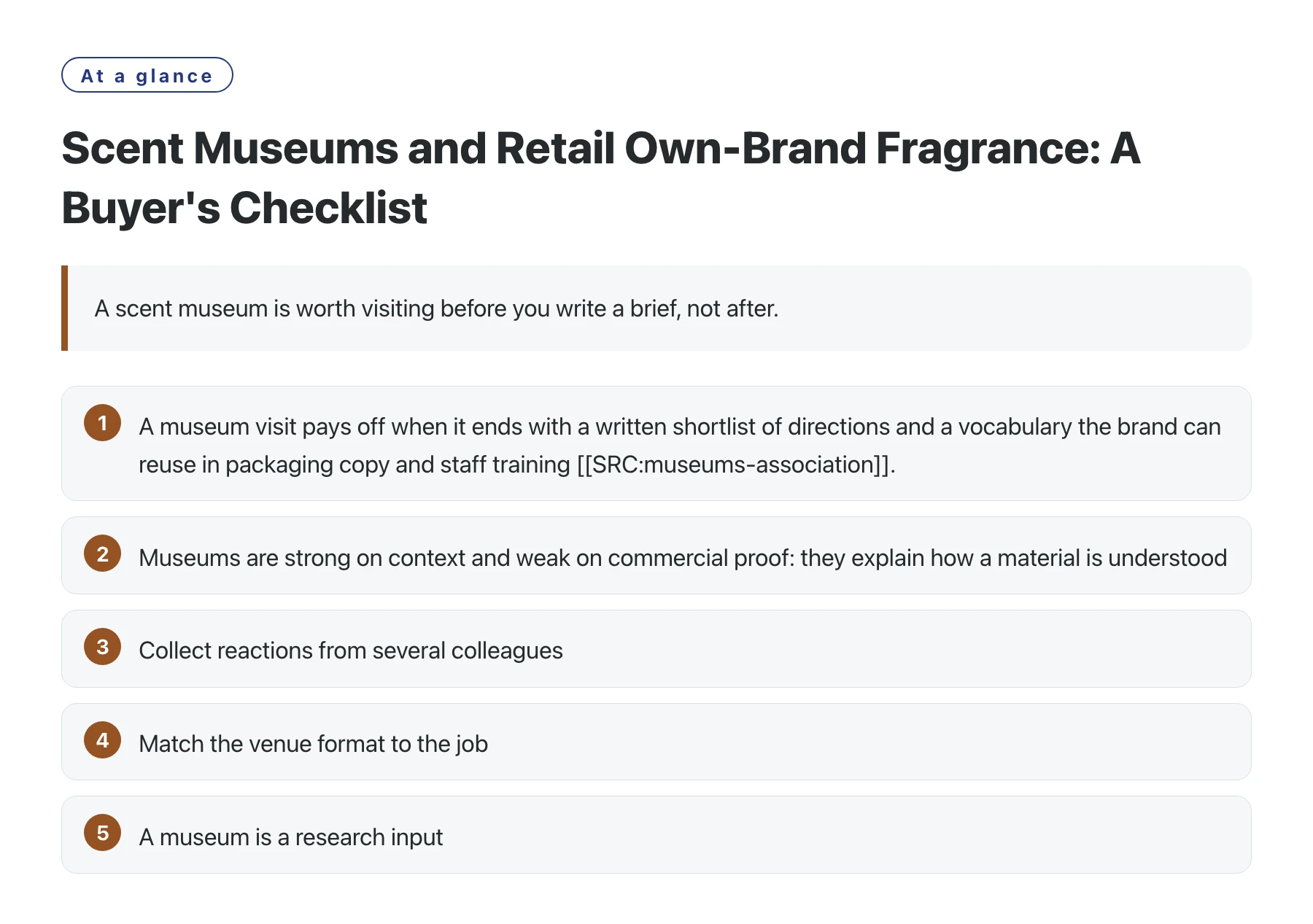
- A museum visit pays off when it ends with a written shortlist of directions and a vocabulary the brand can reuse in packaging copy and staff training [3].
- Museums are strong on context and weak on commercial proof: they explain how a material is understood, not whether your customers will buy it.
- Collect reactions from several colleagues, because smell is read differently by every nose and one opinion is not a product decision.
- Match the venue format to the job, since a guided tour, a blending workshop and a self-guided walk produce different notes and suit different stages of a launch.
- A museum is a research input, not a supplier: repeatability, testing and documentation still have to be demonstrated by a factory.
Retailers usually arrive at fragrance from the shelf side. They know their customer, their price band and the amount of space they can give a display, and they often know very little about how a scent is actually built. A scent museum is one of the few places where that gap can be narrowed in an afternoon.
The risk is treating the visit as a day out. A team that wanders through exhibits and leaves with a pleasant general impression has spent a day and gained nothing it can hand to a product developer.
The checklist below is written for a retailer preparing an own-brand line. It covers what to look at, what to write down, and how to turn those notes into a brief that a factory can answer without guessing.
What a scent museum can and cannot tell you
A fragrance museum exists to explain smell as a cultural and sensory subject. The stronger ones walk a visitor through raw materials, historic scent traditions and the way a finished perfume is composed. For a buyer entering a category for the first time, that is a compact education in the vocabulary their suppliers will use for the next two years.
What no museum can tell you is whether a particular accord will sell in your market at your price point. That judgement comes from your own customers, your shelf data and a factory's ability to reproduce a reference at volume. The museum narrows the question; it does not answer it.
It also helps to know how these venues are run as institutions. ICOM, the international council for museums, maintains the professional standards and the museum definition that shape how collections are presented and interpreted [1], which is why a well-run venue explains context rather than simply displaying objects.
Read the label language, not only the smell
Pay attention to the words used for materials and accords. Many of the raw materials in these exhibits sit inside long craft traditions, and UNESCO's intangible cultural heritage programme is a useful frame for understanding why a material carries the meaning it does [2]. A buyer who can name a material accurately will get a more precise answer from a perfumer than one who describes it as woody and nice.
Notice who the venue is built for
Some venues are designed for school groups, some for industry visitors and some for shoppers. The intended audience shows in whether there is a workshop room, a library, a tasting bar or a retail counter. Choose the one whose audience resembles the stage your own product is at.
Some manufacturers run a scent venue alongside production. The Xuelei Fragrance Museum in Guangzhou, described by the company as the largest of its kind, is one example where a reference collection and a production team sit inside one organisation, which shortens the distance between a reference you liked and a question you can ask.
A checklist for the visit itself
- Book the format you actually needA guided tour, a blending workshop and a self-guided walk produce different notes; confirm what is available before you travel.
- Bring a rough briefWrite down the category, price band and customer you have in mind so the visit has a filter rather than a mood.
- Collect words, not adjectivesRecord the exact terms staff use for a material, because those terms often end up as copy on your packaging.
- Sample in a fixed orderMove from light to heavy and write notes immediately; memory for smell fades faster than memory for text.
- Ask before photographing displaysDisplay structure and finish are usually what a brand can borrow, and permission is quick to obtain if you ask first.
- Set a time limitTwo focused hours beat a full day of fatigue, because the nose stops discriminating long before the legs do.
What to record and what to leave behind
| Item | Worth recording | Why a retail brand cares |
|---|---|---|
| Scent families on display | The three directions your customers already ask for | Gives the brief a starting point instead of a blank page |
| Material names | Local and trade names side by side | Avoids sourcing confusion when a factory quotes |
| Display and packaging ideas | Structure and finish, not branded artwork | Feeds packaging design without copying anyone |
| Visitor reactions | The words people outside your team reach for | Tests whether your positioning language sounds natural |
| Price points in the shop | The observed range only | Sets a reality check on your own target price |
The last row is the one buyers skip. A retail counter inside a museum is a small, self-selected sample of what people pay for scent in an experiential setting, and it is useful as a sanity check rather than as market research. Before the visit, it also helps to read how a supplier describes its own history and scope, because the background published by Xuelei gives you a set of concrete questions rather than a general chat.
From visit notes to a production brief
Back at the office, the notes have to survive contact with a factory. A brief built only on mood language comes back as a guess. A brief built on three named directions, a price band, a bottle format and a launch window comes back as a plan with lead times attached to it.
This is where a contract manufacturer for perfume brands earns its place. The useful first conversation is about which of your three directions can be developed inside your cost and timeline, not about which one the supplier personally prefers.
Keep one reference the factory cannot reinterpret
Take a physical reference home if the venue sells samples, or ask the supplier to send one. A retained sample with a date and a reference code is the only artefact that settles a later disagreement about what was approved.
Write down who owns the development
If the direction came from a supplier's existing library, ask whether it is exclusive to you. A direction you loved in a museum is not an asset until the ownership question is answered in writing.
The most common mistake is treating the museum as a sourcing shortcut. It is the cheapest part of the project and the easiest to over-value. Spend the money on the visit, then spend the same attention on the three questions that decide the launch: can this be reproduced, can it be documented for my market, and can it be made at my price.
Sources
- ICOM — International Council of Museums —— The international organisation representing museums; publishes the ICOM museum definition and professional standards for museum practice.
- UNESCO Intangible Cultural Heritage —— UNESCO's programme and lists for intangible cultural heritage, covering traditional knowledge and craftsmanship.
- Museums Association —— A professional body for museums, publishing guidance and research on museum practice and visitor experience.
Frequently asked questions
Is a scent museum useful if my team has no fragrance experience?
Yes, and that is the case where it helps most. The vocabulary and the material references are the main gain. Expect to leave with better questions rather than with a finished product idea.
How many people should attend?
Three to five is workable. Below that you get one perspective, above that the group cannot sample in the same order and the notes stop being comparable.
Can I use a museum's exhibit design as a packaging reference?
Ask the venue first. Structure, proportion and finish are reasonable things to study; branded artwork, photography and text are not yours to reuse.
Should I visit before or after choosing a factory?
Before, if the category is new to you. After, if you already have a brief and want to test it against a wider reference set. Visiting first usually produces a tighter brief.
What does a manufacturer-run scent venue add?
It puts a reference collection and a production contact in one organisation. Xuelei, for example, describes its Guangzhou museum as the largest of its kind; that is the company's own description and should be read as positioning rather than as an audited fact.