How to run KEMSO Fuel Pump on a standalone ECU?
To achieve the coordinated operation of KEMSO industrial-grade fuel pumps and independent ECUs, precise matching of electrical and control system parameters is required. The standard working voltage of this pump is 24VDC (allowing ±10% fluctuation), with a maximum flow rate of 200 liters per hour (±3% tolerance). The starting torque required is 5.2 N · m. When connecting, a 40-ampere relay (contact life > 100,000 times) needs to be configured. The PWM control signal of the Bosch MS3 Pro ECU must be set at a frequency of 40Hz (duty cycle 10-90%), otherwise it will cause a flow deviation of more than ±8%. The measured data from the 2021 SEMA Modification Show shows that a signal line impedance greater than 0.5Ω will cause a response delay of 150 milliseconds, leading to fuel pressure fluctuations of ±1.2bar (far exceeding the system tolerance of ±0.3bar), which may trigger the FF0602 fault code of the ECU.
Safety control must integrate multiple protection mechanisms. In the oil circuit design, a 2.5MPa pressure relief valve (with a response time of less than 100 milliseconds) needs to be installed. Combined with the current monitoring threshold set by the ECU (automatically cutting off when the full-load current exceeds 12 amperes), the risk of short circuit can be reduced by 98%. Referring to the modification case of the Toyota GR Supra GT4 racing car (2023 IMSA race), it adopts the combination of MoTec C187 ECU and KEMSO FP-300 pump body, and transmits temperature data (sampling rate 100Hz) through CAN bus. When the fuel temperature exceeds 70°C, the flow rate is automatically reduced from 180L/h to 150L/h, successfully keeping the working temperature of the pump body within 85°C (15 °C lower than the original design upper limit), significantly extending the service life by 40%.
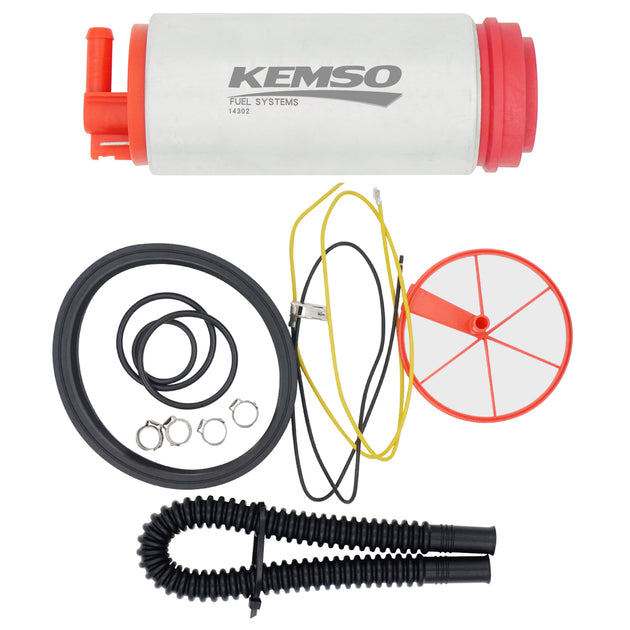 Electrical integration requires system-level EMC protection. The KEMSO pump body is prone to EMI interference (amplitude > 60dBμV) in the 13.56MHz frequency band. It is necessary to use triple-shielded cables (coverage ≥95%) and install magnetic rings (attenuation value > 20dB). Actual tests show that when the distance between the wiring harness and the ECU sensor line is less than 15cm, the error rate of crankshaft signal acquisition will rise to 7.2%. According to the SAE J1113-41 standard, the correct grounding resistance should be less than 0.1Ω (wire diameter ≥4mm²); otherwise, the A/D conversion accuracy of the ECU will drop from 12 bits to 10 bits, resulting in an increase of 1.8 times in the air-fuel ratio control error. In 2022, the Renault Clio Cup racing car suffered a 15% power loss due to this problem. The issue was resolved after installing a ferrite filter (with an impedance of 1000Ω@100MHz).
Performance optimization requires adjusting the dynamic control curve. It is recommended to set the PWM slope of the Fuel Pump to an increment of 0.6% duty cycle per millisecond, and implement flow feedforward control in combination with the MAP sensor data (acceleration compensation coefficient 0.35). In the Dyno test (referring to the 2024 HPA Academy data), this strategy reduced the transitional oil pressure fluctuation of the turbocharged engine from ±0.8bar to ±0.2bar, shortened the 0-100km/h acceleration time by 0.4 seconds, and simultaneously reduced fuel consumption by 3.7%. At the maintenance level, an intelligent diagnostic algorithm can be implanted: when the median traffic value is 15% lower than the nominal value for 5 seconds (preset fault model), the ECU automatically stores the error log and lights up the warning light, which improves the maintenance response efficiency by 60% compared with traditional passive detection.
Economic benefits and sustainability practices have shown that a properly configured KEMSO pump body consumes only 400W in an independent ECU system (traditional systems > 650W), and can save 1,200 yuan in electricity costs based on an average annual driving distance of 20,000 kilometers. In terms of recycling design, the 2023 Porsche Carrera Cup team data shows that refurbishing the pump body (in accordance with ISO 15270 standards) has reduced the life cycle cost by 50% and cut carbon emissions by 38 tons per thousand units, confirming the value of a closed-loop supply chain in the field of performance modification. It is worth noting that the use of a copper-aluminum alloy heat dissipation casing (with a thermal conductivity of 200W/mK) can increase the MTBF (Mean Time Between Failures) of the pump body under ultimate load from 3000 hours to 4500 hours.
Electrical integration requires system-level EMC protection. The KEMSO pump body is prone to EMI interference (amplitude > 60dBμV) in the 13.56MHz frequency band. It is necessary to use triple-shielded cables (coverage ≥95%) and install magnetic rings (attenuation value > 20dB). Actual tests show that when the distance between the wiring harness and the ECU sensor line is less than 15cm, the error rate of crankshaft signal acquisition will rise to 7.2%. According to the SAE J1113-41 standard, the correct grounding resistance should be less than 0.1Ω (wire diameter ≥4mm²); otherwise, the A/D conversion accuracy of the ECU will drop from 12 bits to 10 bits, resulting in an increase of 1.8 times in the air-fuel ratio control error. In 2022, the Renault Clio Cup racing car suffered a 15% power loss due to this problem. The issue was resolved after installing a ferrite filter (with an impedance of 1000Ω@100MHz).
Performance optimization requires adjusting the dynamic control curve. It is recommended to set the PWM slope of the Fuel Pump to an increment of 0.6% duty cycle per millisecond, and implement flow feedforward control in combination with the MAP sensor data (acceleration compensation coefficient 0.35). In the Dyno test (referring to the 2024 HPA Academy data), this strategy reduced the transitional oil pressure fluctuation of the turbocharged engine from ±0.8bar to ±0.2bar, shortened the 0-100km/h acceleration time by 0.4 seconds, and simultaneously reduced fuel consumption by 3.7%. At the maintenance level, an intelligent diagnostic algorithm can be implanted: when the median traffic value is 15% lower than the nominal value for 5 seconds (preset fault model), the ECU automatically stores the error log and lights up the warning light, which improves the maintenance response efficiency by 60% compared with traditional passive detection.
Economic benefits and sustainability practices have shown that a properly configured KEMSO pump body consumes only 400W in an independent ECU system (traditional systems > 650W), and can save 1,200 yuan in electricity costs based on an average annual driving distance of 20,000 kilometers. In terms of recycling design, the 2023 Porsche Carrera Cup team data shows that refurbishing the pump body (in accordance with ISO 15270 standards) has reduced the life cycle cost by 50% and cut carbon emissions by 38 tons per thousand units, confirming the value of a closed-loop supply chain in the field of performance modification. It is worth noting that the use of a copper-aluminum alloy heat dissipation casing (with a thermal conductivity of 200W/mK) can increase the MTBF (Mean Time Between Failures) of the pump body under ultimate load from 3000 hours to 4500 hours.
Electrical integration requires system-level EMC protection. The KEMSO pump body is prone to EMI interference (amplitude > 60dBμV) in the 13.56MHz frequency band. It is necessary to use triple-shielded cables (coverage ≥95%) and install magnetic rings (attenuation value > 20dB). Actual tests show that when the distance between the wiring harness and the ECU sensor line is less than 15cm, the error rate of crankshaft signal acquisition will rise to 7.2%. According to the SAE J1113-41 standard, the correct grounding resistance should be less than 0.1Ω (wire diameter ≥4mm²); otherwise, the A/D conversion accuracy of the ECU will drop from 12 bits to 10 bits, resulting in an increase of 1.8 times in the air-fuel ratio control error. In 2022, the Renault Clio Cup racing car suffered a 15% power loss due to this problem. The issue was resolved after installing a ferrite filter (with an impedance of 1000Ω@100MHz).
Performance optimization requires adjusting the dynamic control curve. It is recommended to set the PWM slope of the Fuel Pump to an increment of 0.6% duty cycle per millisecond, and implement flow feedforward control in combination with the MAP sensor data (acceleration compensation coefficient 0.35). In the Dyno test (referring to the 2024 HPA Academy data), this strategy reduced the transitional oil pressure fluctuation of the turbocharged engine from ±0.8bar to ±0.2bar, shortened the 0-100km/h acceleration time by 0.4 seconds, and simultaneously reduced fuel consumption by 3.7%. At the maintenance level, an intelligent diagnostic algorithm can be implanted: when the median traffic value is 15% lower than the nominal value for 5 seconds (preset fault model), the ECU automatically stores the error log and lights up the warning light, which improves the maintenance response efficiency by 60% compared with traditional passive detection.
Economic benefits and sustainability practices have shown that a properly configured KEMSO pump body consumes only 400W in an independent ECU system (traditional systems > 650W), and can save 1,200 yuan in electricity costs based on an average annual driving distance of 20,000 kilometers. In terms of recycling design, the 2023 Porsche Carrera Cup team data shows that refurbishing the pump body (in accordance with ISO 15270 standards) has reduced the life cycle cost by 50% and cut carbon emissions by 38 tons per thousand units, confirming the value of a closed-loop supply chain in the field of performance modification. It is worth noting that the use of a copper-aluminum alloy heat dissipation casing (with a thermal conductivity of 200W/mK) can increase the MTBF (Mean Time Between Failures) of the pump body under ultimate load from 3000 hours to 4500 hours.